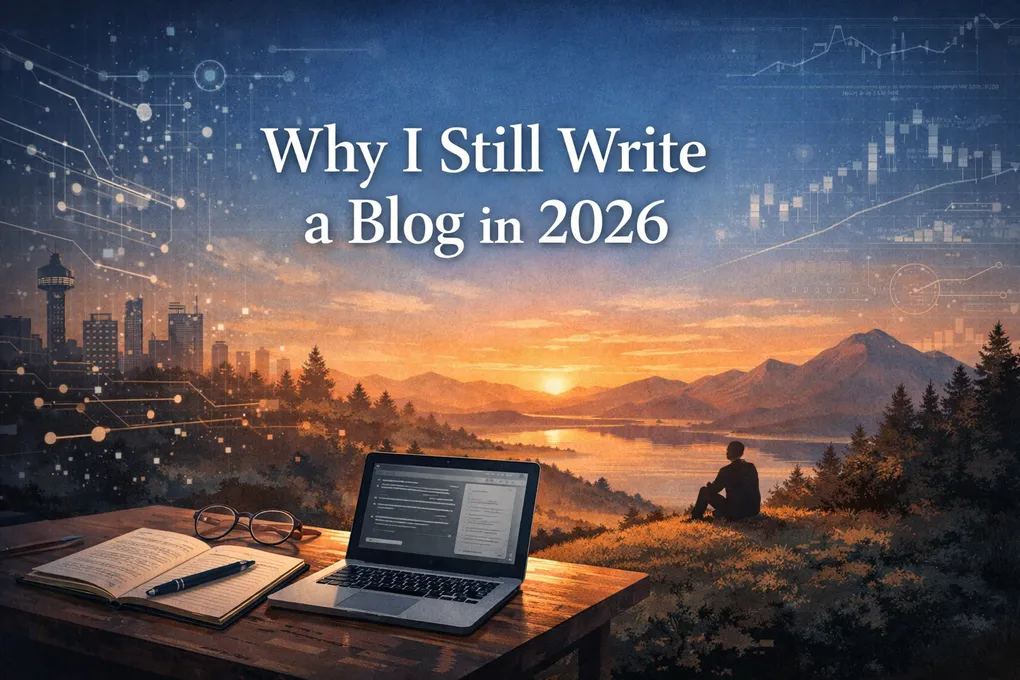
Why I still write a blog in 2026?
In 2026, writing a blog feels almost anachronistic.
We have AI that can summarize entire fields in seconds. We have feeds optimized to surface “what matters” without asking us to think too hard. We have platforms where distribution is instant and frictionless.
And yet, I still write a blog.
Not as a growth hack. Not as a content strategy. And definitely not because I think the world needs more words.
I write a blog because it solves a different problem—one that modern platforms don’t.
The Internet Optimized for Speed, Not Thinking
Most modern platforms optimize for immediacy:
- Fast publishing
- Fast feedback
- Fast forgetting
They reward clarity in the moment, not coherence over time.
That’s not a moral critique—it’s simply how incentives work. Feeds are great for what’s happening now. They are less great for how someone thinks.
But the questions I care about don’t resolve in a week:
- How do I make decisions under uncertainty?
- Where do engineering trade-offs actually matter?
- How does risk compound quietly—both in systems and in portfolios?
- What did I believe that turned out to be wrong?
These questions don’t fit well into timelines.
They need space.
A Blog Is Not a Feed. It’s a Record.
I don’t think of this blog as a publishing platform. I think of it as a decision log.
A place where:
- Ideas are allowed to be incomplete
- Assumptions are written down before outcomes are known
- Context is preserved instead of optimized away
Writing here forces me to slow down and make my thinking legible—not just to others, but to my future self.
In a year, I want to be able to point to a post and say:
“This is what I believed at the time—and this is why.”
That’s hard to do in places designed for performance rather than memory.
Writing as a Filter, Not a Broadcast
This blog is not meant for everyone.
That’s intentional.
If you’re looking for:
- Hot takes
- Market timing
- Tactical advice
You’ll probably be disappointed.
What I’m interested in documenting instead:
- How I reason about systems (technical and financial)
- Where incentives break
- Why certain choices felt right before they worked—or failed
- What trade-offs I consciously accepted
Writing this way naturally filters the audience. The people who stay are usually the ones I’d want to talk to anyway.
Why Not Let AI Do This?
AI is excellent at synthesis. It’s less good at ownership.
It can tell you what usually works. It can’t tell you what you chose, given your constraints, your risk tolerance, and your blind spots.
This blog exists precisely in that gap.
Not to compete with AI, but to complement it:
- AI summarizes the map
- Writing records the path I actually took
Why Public?
Because private notes lie.
When something is public—even to a small audience—it demands a higher standard:
- Clearer definitions
- Explicit assumptions
- Fewer hidden shortcuts
Public writing introduces accountability without performance. That tension is useful.
What to Expect Here
I’ll mostly write about three things:
- Engineering — systems, architecture, and the cost of technical decisions
- Investing — not recommendations, but frameworks, risk, and post-mortems
- Thinking — how I reason about uncertainty, incentives, and long-term trade-offs
The goal isn’t to be comprehensive. It’s to be honest.
Why I Still Write a Blog
Because some ideas deserve to be slow. Because memory matters. Because clarity compounds.
And because, even in 2026, the most reliable way I know to improve my thinking is still this:
Sit down. Write clearly. And leave a record.